Last December I was shopping in the thrift store for picture frames. I am always on the lookout for interesting old frames with ugly art in them. I repurpose the art and use the frames for my own work.
One frame had a rough-hewn rustic look, with cracked glass and nails holding the back on. Just my kind of thing! It was priced at a very reasonable 500 yen. And the art inside was surprisingly charming.

By the time I got it home, I was quite intrigued by the pastel sketch. It was marked in pencil on the mat:
フランス セーヴルの町
1929 HARUKA UENO
I decoded the katakana as Sèvres, France and I decided to look up the artist. I found her in a Tateyama recycle shop, maybe she was local. It’s really hard to dig up information about local artists online, so I wasn’t especially hopeful. But what I found was a treasure.
Haruka Ueno went to Paris in 1928 at age 32 to study Western painting. Later she travelled the world and got especially interested in painting the Himalayas. She had success as an artist. She exhibited many times; her works hang in museums in her hometown of Sapporo and you can find them at auction for anywhere from 20,000 – 66,000 yen. She died in her atelier in Tokyo at age 82 in 1978.
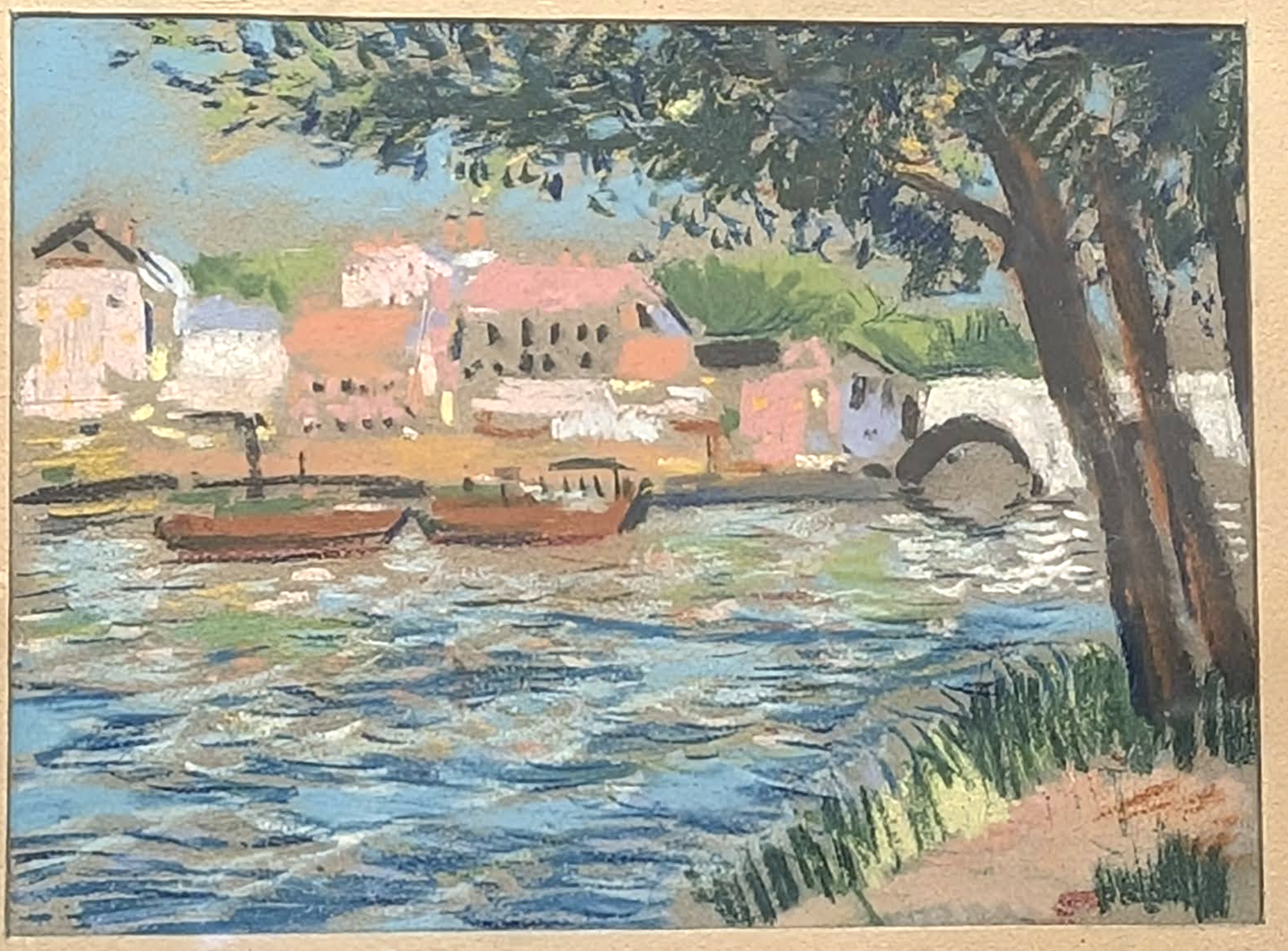
Her drawing from Sèvres shows the old arched stone bridge built by Napoleon over the Seine. There was a park that afforded a good perspective of the bridge and river. The park is still there at Ile de Monsieur, though seems to be a riverbank rather than an island.


There are some famous paintings of Pont de Sèvres before it was replaced in 1963: Sisely captured it in 1877, Henri Rousseau in 1908, the cubist Oleksandra Ekster made it weird, and Henri Matisse did an oil sketch of the bridge from the opposite direction of Ueno’s


But Ueno’s pastel sketch captured my imagination. Paris was a magnet for Japanese artists in the 1920s. There were hundreds of painters from Japan – so many that they’d broken into three artistic factions by the end of the 20s. Ueno was clearly in the camp of the Realists influenced by by Yūzō Saeki. Henri Matisse sometimes collaborated at the school she probably attended, the Académie de la Grande Chaumière in Montparnasse. This was a summer of writers, too with Ernest Hemingway, F. Scott Fitzgerald, and James Joyce living in the milieu.
Just before her death, Ueno published a book of essays about her time in Paris and her travels, 紋白蝶 (The Cabbage White Butterfly). But there were only 1000 copies printed; it is a collector’s item that I will probably never get to read. So I invented my own story of this sketch.
It is summer of 1929 and she’s been in Paris for about year. There was a great heatwave and drought that summer. She has gone down to the river for a picnic and plein air painting. Maybe with friends, but I think she was lonely even in a crowd. She sat in the shade of a tree and captured its dense leaves and the long grass underneath but not a single figure. The heat reflects off the water disturbed by the wake of boats, the roof tiles glow pink, the white walls and stone bridge almost shimmer with warmth. She captured it perfectly. I feel like I am right there with her.
Needless to say, I decided not to repurpose her drawing to use the frame for myself. I set it aside for a time when I could get the frame fixed and the drawing rematted.

And that time was today. An article in the Bonichi Shimbun reminded me about Gallery Hiroi, where I met the weaver, Morita Seki, in February. Once again, the Bonichi lit a fire under me and I grabbed the artwork and headed down to Tateyama with Tod.
The gallery owner, Kyoko Hiroi, is an artist herself and she does the framing. I explained that I wanted to re-mat the drawing to fit the frame better and preserve the signature on the old mat. She immediately started describing what she’d do to set up a double mat, told me it would take an hour or so, and I could wait if I wished. She ran off to get her tools.


The nails came out and inside the frame were some interesting little mysteries that kept me occupied during the wait.
One was a print of Pont Royal and the Pavillon de Flore by Camille Pissarro. This must have been what was featured in the frame before Ueno’s pastel sketch. It’s printed on a textured coated paper that feels like wallpaper.
And we found a page from a Nippon Paint Calendar with no year noted. But a key detail is that Christmas was on a Tuesday. Added to the clues of the neo-grotesque typeface and the subject matter of the puppy with milk bottle, 1956 and 1962 are the candidate years. Based on the pale jade background and the color palette of the type, this is a 1956 calendar.
But my favorite moment was seeing was the back side of the drawing. The paper is surprisingly thin. The flecked grey color is invisible from the front. And check out the tiny perforations from the sketchbook.

This detail of the artist’s life fills my heart. This artwork is not merely a landscape drawn on a hot summer day, it’s a moment in a life. You can see she carefully removed the sketch from her book. For a friend? To sell for rent money?
I will never know how this drawing ended up with me through its complicated chain of custody almost 100 years long, but I am grateful that it lives here now. I brought the newly matted, improved frame home and hung it next to my bed, where I can enjoy it every day.