My friend Greg and I had a wide-ranging conversation yesterday, centered around a creative question.
“How do you decide what to do?”
We both have art studios filled with supplies and have enough time to work on our ideas. It can be overwhelming to choose a project, especially with a steady diet of inspirations from the Internet, online classes, books, and other distractions. So what motivates me?
I do what captures my attention the most strongly.
When I hit on an idea, I feel it in my whole body.
I’ve heard that feeling described as a creative fire, but for me it’s more like a compulsion. I must do whatever it is, or it won’t stop tickling my brain. My mind flies from a spark to a plan, and I have a yearning to begin. I think visually; I work out details as I go. If I don’t act on the idea, I will feel off-kilter, antsy, even angry or depressed.
I have a reputation for getting things done quickly because if I wait, doubts will creep in or the idea will fade away or be replaced with a different idea. It’s as if my brain turns on a light to illuminates the path for my hands and mind to explore. The rest of the world is in the shadows.
I’ve always been this way. Its a combination of autism and ADHD, I suppose.
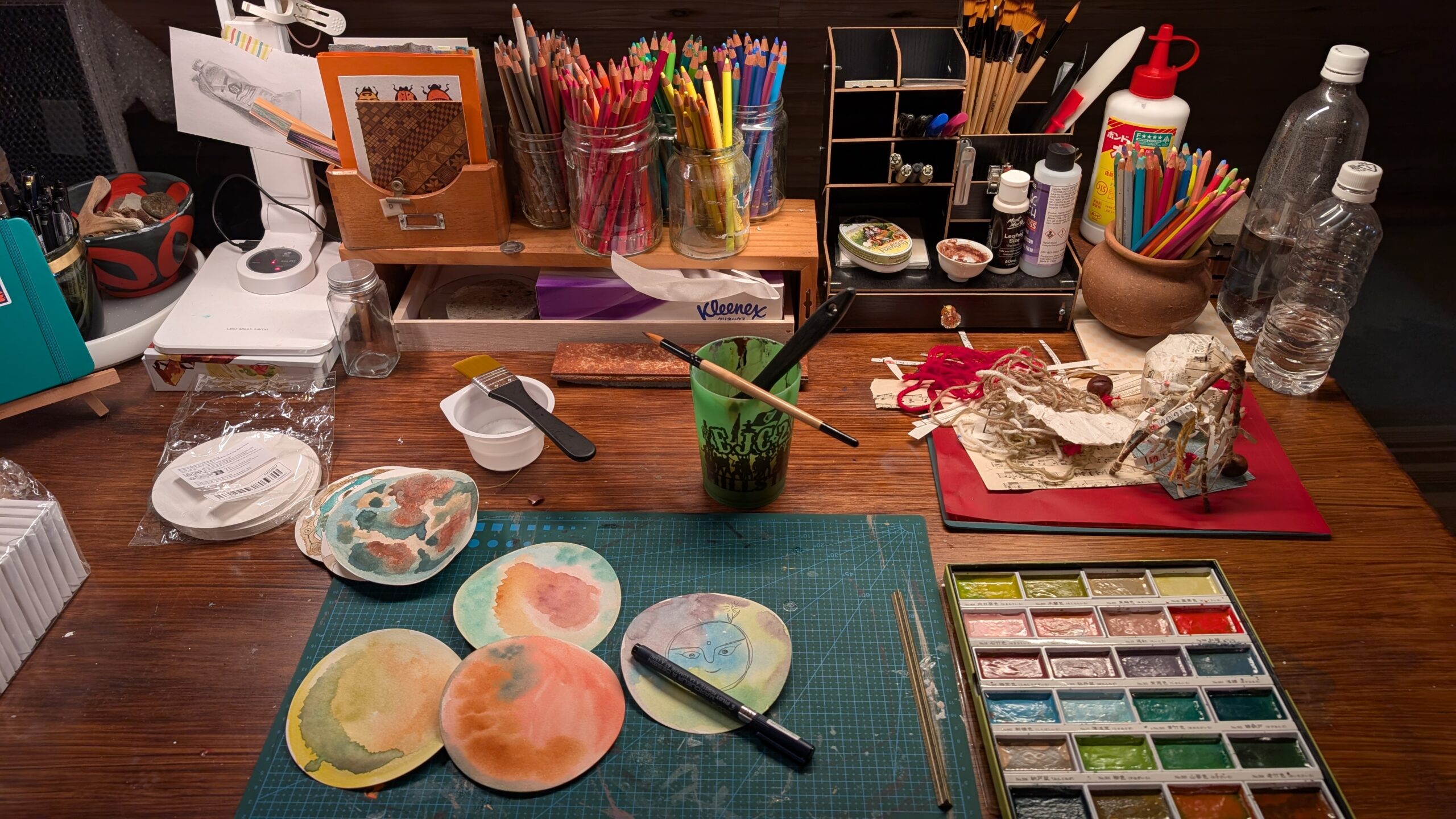
Sometimes my creative attention lasts for years (hula hoops and circus acts from 2008-2015, yoga classes from 2015-2025), sometimes mere minutes (tidying my studio table for a photo this morning). There are themes and mediums I come back to over and over in different ways.
Over the years I have built up some precepts that help me along the way and keep me from feeling overwhelmed.
IN THE STUDIO
- Keep things visible. I don’t have every art supply on display, but I do have reminders in eyeshot. Finished projects that I like. Labels on storage boxes and drawers. Jars with pencils. My favorite tools. A large bottle of glue. Half-finished projects set to the side.
- Messy is fine, trashed isn’t. Despite my father’s edict to put away my tools when I was finished with them, I often don’t. Seeing a brush and dirty paint water on the table means no friction to sitting down to use them again. But piles of “for later” items tend to grow on my table and those get culled regularly.
- Work with what you have…says the woman with two studios, TEMU on speed-dial, and a garden full of resources…but I am as happy arranging flowers on a sunny rock as I am weaving tapestries or painting on canvas at an easel. Creativity truly doesn’t need me to get fancy stuff.
- Time will find itself. I don’t keep a strict creative schedule. When I am caught in a creative fire, I make time for it. If time is scarce, I carve into unused edges and moments of waiting.
Having my environment in order isn’t even half the battle. The bigger part is in my head. My inner critic has thrown me a lifetime of hurdles. I have finally learned how to ignore him. He still whispers to me, but not loud enough to stop me.
IN MY MIND
- Process over product. I love who I am when I am creating. The truest parts of me are the childlike wonder, flowing intuition, and imaginative expression I tap into when I create. It doesn’t matter what I make: blog post, tapestry, birthday cake. Even decluttering or cleaning and let me tap into the delight of process.
- Others’ opinions are beside the point. Sometimes my finished product lands well with other people. Usually there are polite nods. I have learned to let reactions – good and bad – be less relevant than my own satisfaction in the process.
- FAFO unabashedly. I delight in “fucking around and finding out” my way through everything. Creative problem solving is the most excellent kind of fun. Give me some materials and let me play; I will figure something out. Curiosity and creativity go hand in hand.
- Quantity over quality. There’s a useful story I have taken to heart about a teacher who divided his pottery class into two. One group was tasked to make a single perfect pot; the other group had to make as many pots as possible. The better pots came from the second group because they felt free to explore, make mistakes, and learn. Is it ironic that practice makes improvement?
- Imperfection is necessary. When I visited the UN in New York as a young woman, I learned the Iranian carpets on display in the lobby had intentional imperfections because “only God is perfect.” That stuck with me. Imperfections in technique are what give art its style and how you know the work is mine and not the work of a god, AI, or another artist.
- Abandonment isn’t failure. Like everyone, I start things but stop before finishing. Usually whatever I was working on gets pushed to the side to make room for a stronger compulsion. Sometimes I rekindle an interest to complete it, or at least noodle with it in between other things. It’s fine if it doesn’t ever get touched again.
Thanks, Greg, for asking. This was a much longer answer than I expected.